1. Tracking usage #
Knowing before paying.
Tools #
- Plan & Usage: consumption per product, compared with the contract commitment.
- Usage Attribution: breakdown of consumption by tag (
team,service), to charge back or make teams accountable. - Estimated usage metrics (
datadog.estimated_usage.*) on which to set monitors: be alerted to a spike in logs or custom metrics the same day, not on the bill.
# Monitor : volume de logs ingérés anormal pour un service
sum(last_1h):sum:datadog.estimated_usage.logs.ingested_bytes{*} by {service}.as_count() > 50000000000
2. Reducing #
The levers.
Levers #
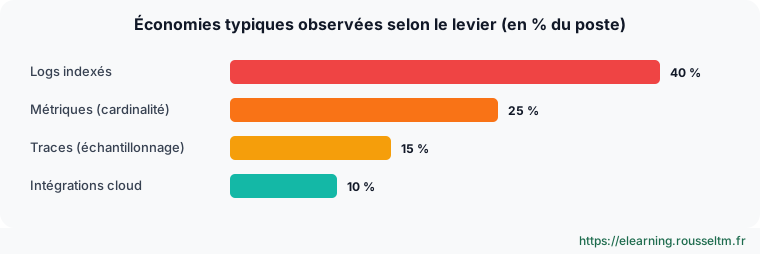
Good practice: Tackle the largest item on your bill first, often indexed logs or custom metrics, and measure the effect of each measure on estimated usage.
3. Governing #
Who can do what.
Rules #
| Topic | Practice |
|---|---|
| Access | SAML SSO, roles (Admin, Standard, Read Only) and custom roles; restricting sensitive data with restriction queries |
| Teams | Datadog Teams linked to services, dashboards and monitors |
| Tags | Tag policies (mandatory tags on monitors, team and env everywhere) |
| Configuration | Monitors, dashboards, SLOs and Synthetics tests in Terraform, reviewed in pull requests |
| Organizations | Child organizations per entity if data and billing need to be isolated |
My progress
Sign in to track your progress and take notes. Sign in
💬 Recent discussions about this course
- Datadog : relier traces, logs et métriques du même service✓ solved · 1 reply(ies)
Ask a question about this lesson →See all discussions about this course
Recommended Articles
Datadog best practices: tags, costs, alerts and governance
Checklist for using Datadog effectively: unified tagging, cost control (hosts, logs, custom metri...
Cloud best practices: security, resilience, costs and operations
Cloud computing best practices: pillars of a well-architected design, IAM and least privilege, mu...
Dynatrace security and governance: advanced IAM, policies, SSO, audit and data protection
Secure and govern Dynatrace: SSO and SCIM, groups, IAM policies with conditions, security context...
Datadog: the SaaS observability platform at a glance
What Datadog is, its products (infrastructure, logs, APM, RUM, synthetics, security), its concept...
Azure best practices: landing zone, security, reliability and costs
Best practices for running Azure in production: landing zone and management groups, identities an...
Dynatrace: management zones, segments and IAM policies
Management zones on the classic platform, segments on the new platform and IAM policies: what eac...
Dynatrace licensing and FinOps: rate cards, consumption tracking and budgets
Apply a FinOps approach to Dynatrace: understand the DPS rate card, track consumption per capabil...
Datadog on Kubernetes: Operator, Cluster Agent and Autodiscovery
Monitor Kubernetes with Datadog: the Datadog Operator and the DatadogAgent resource, Cluster Agen...
Advanced Datadog APM: sampling, retention, profiler and Software Catalog
Go further with Datadog APM: ingestion control and sampling, retention filters, trace metrics, Co...