1. Governance #
Protecting what matters.
Guardrails #
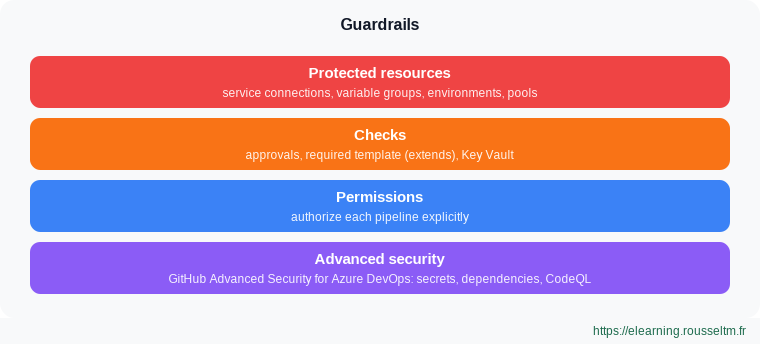
- Access through Microsoft Entra ID, groups and access levels (Stakeholder, Basic, Basic + Test Plans); short-lived, minimal-scope personal access tokens.
- Secrets come from Azure Key Vault (linked variable group or
AzureKeyVault@2task) and are never written in the YAML. - The organization audit log traces permission, policy and connection changes; it can be streamed to a SIEM.
2. Troubleshooting and checking #
The most common errors.
Frequent errors #
| Symptom | Likely cause |
|---|---|
| No hosted parallelism has been purchased or granted | free grant not requested: use a self-hosted agent or request it |
| "This pipeline needs permission to access a resource" | protected resource: authorize the pipeline once |
| Job waiting without agent | no online agent with the requested capabilities |
| Empty secret variable in a script | not passed through env: |
The system.debug: true variable enables detailed logs; the "Download logs" view retrieves the whole run.
Checklist #
| Item | Check |
|---|---|
| Repos | policies on main: reviewer, build validation, linked items |
| Pipelines | multi-stage YAML, shared templates, versioned tasks |
| Security | OIDC, Key Vault, protected resources, separate pools |
| Delivery | environments with approvals, same artifact promoted |
Good to know : GitHub Advanced Security for Azure DevOps brings secret scanning with push protection, dependency scanning and code scanning (CodeQL) directly into Azure Repos (paid option per active committer).
Commands to know #
Commands to know
az devops security group list -o table: security groupsaz pipelines variable-group variable create --secret true …: secret variableaz devops invoke --area audit --resource auditlog: query the audit log
Sources #
Checked in November 2026: CI/CD platforms change every month, check versions and plans in the vendor's documentation.