1. Agile and DevOps #
Deliver often, all the way to production.
Scrum and Kanban #
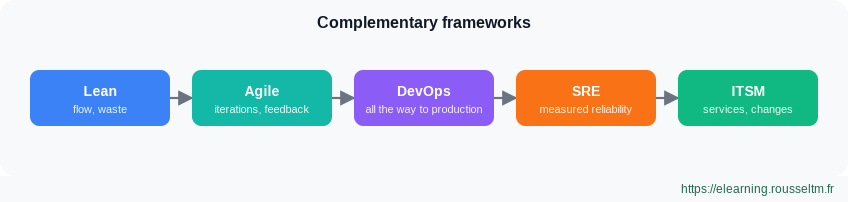
The agile manifesto (2001) values individuals, working software, customer collaboration and responding to change. DevOps is its natural extension: an agile team that delivers every two weeks but waits a month for a release is only half agile.
| Criterion | Scrum | Kanban |
|---|---|---|
| Cadence | 1 to 4 week sprints | continuous flow |
| Roles | Product Owner, Scrum Master, developers | no mandatory roles |
| Steering | commitment to a sprint goal | work-in-progress (WIP) limits |
| Metrics | velocity, burndown | lead time, throughput, cumulative flow diagram |
| Suited to | plannable product development | operations, support, interrupt-driven work |
2. Lean #
Smoothing the value stream.
Lean thinking #
- Value and flow: identify what the customer pays for, map the value stream and remove what adds nothing to it.
- Software waste (Poppendieck): partially done work, extra features, relearning, handoffs, delays, task switching, defects.
- Theory of constraints (Goldratt): a system's throughput is set by its bottleneck; improving anywhere else is useless. Five steps: identify, exploit, subordinate, elevate, repeat.
- Little's law: average lead time = work in progress / throughput. At equal throughput, halving work in progress halves lead time: that is why WIP is limited.
- Kaizen: small continuous improvements, decided by those who do the work.
Best practice : Before automating a step, ask whether it is the bottleneck: automating a fast step does not shorten overall lead time.
3. ITSM and ITIL 4 #
Managing services without slowing down.
ITSM and ITIL 4 #
| ITIL 4 practice | DevOps reading |
|---|---|
| Change enablement | standard changes pre-approved and automated by the pipeline; normal changes peer-reviewed; emergency changes traced |
| Incident management | restore service as fast as possible: on-call, incident roles |
| Problem management | find and remove the cause: blameless post-mortem and tracked actions |
| Release management | decoupled from deployment thanks to feature flags |
| Service level management | SLOs and error budgets |
ITIL 4 is not the opposite of DevOps: its value system and guiding principles (focus on value, progress iteratively, collaborate, automate) are compatible. What changes is how control works: a weekly change advisory board (CAB) is replaced by automated controls and peer reviews, which are more reliable and faster.
Good to know : DORA research shows that external change approval is associated with lower performance, without any stability gain: separation of duties can be ensured by the pipeline (mandatory review, deployment by a service account).
4. Culture #
The precondition for everything else.
Organizational culture #
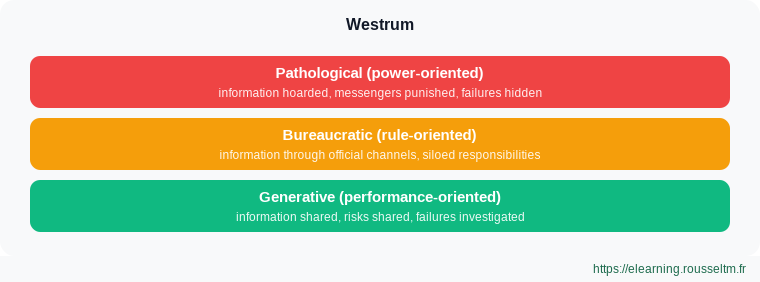
- The Westrum typology classifies organizations by how information flows; a generative culture predicts better delivery performance and well-being.
- Psychological safety (Amy Edmondson, Google's Aristotle study): being able to report a mistake or doubt without fear; it is the first condition of an effective team.
- Just culture distinguishes honest error (improve the system) from deliberate negligence: it makes blameless post-mortems possible.
- The learning organization practices experimentation, sharing (communities of practice, demos) and dedicated improvement time.
Watch out : Buying tools without changing how information flows reproduces silos with new software.
Commands to know #
Commands to know
gh issue list --label "en cours" --state open | wc -l: a team's work in progress (WIP)gh pr list --state merged --limit 100 --json createdAt,mergedAt: pull request lead timesgit log --since="30 days ago" --oneline main | wc -l: change throughput over 30 days
