1. Starting point #
Know where you start and where you are going.
Assess and choose a pilot #
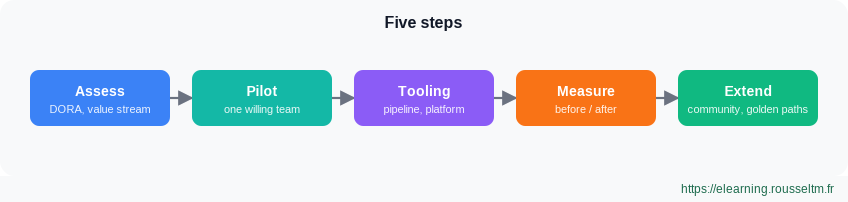
- Measure the starting point: the four DORA metrics (even estimated), a value stream map of one request, the time spent on unplanned work.
- Set a business goal: "ship a fix in less than a day", rather than "adopt Kubernetes".
- Choose a willing pilot team, with a visible but not the most critical product, and give it time and support.
- Tackle the main constraint of the flow (often manual tests, environments or approvals), not everything at once.
2. Leading change #
People before tools.
Leading change #
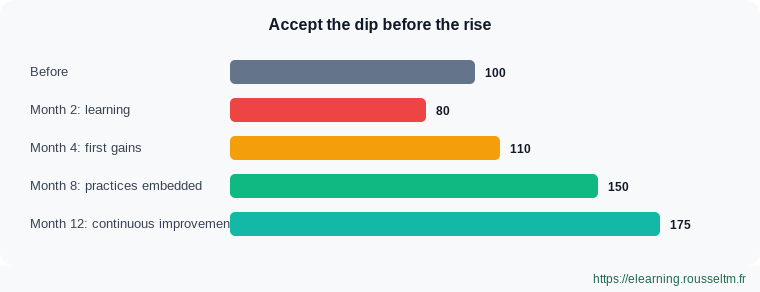
- The J-curve: performance dips during learning before exceeding the initial level; announce it so you do not give up in the dip.
- Sponsors in leadership, relays in teams (champions, communities of practice, dojos) and visible wins shared regularly (demos, before/after figures).
- Move from project funding (team disbanded at delivery) to product funding (long-lived team, accountable over time).
- Review incentives: you cannot ask for collaboration while rating developers on speed and operators on stability.
3. Pitfalls and organizational models #
What makes it fail, what helps.
Anti-patterns #
| Anti-pattern | Symptom | Remedy |
|---|---|---|
| DevOps team silo | a new team between Dev and Ops, receiving tickets | self-service platform team, or temporary enabling team |
| Renamed Ops | same organization, new job titles | change responsibilities: you build it, you run it |
| Tools first | platform purchase, unchanged practices | start from the value stream and metrics |
| Big bang | every team at once, no feedback | extend in waves from the pilot |
| Gamed metrics | inflated deployment frequency, hidden incidents | measure teams to improve, never to rank people |
Team Topologies organizational models help choose: stream-aligned teams, platform team (X-as-a-Service interaction), enabling team (temporary coaching), complicated-subsystem team; three interaction modes: collaboration, X-as-a-Service, facilitating.
4. Roadmap #
Move forward in measured steps.
Roadmap #
| Horizon | Typical goals |
|---|---|
| 30 days | baseline metrics, pilot chosen, build pipeline and automated tests on the pilot |
| 60 days | automated staging deployment, infrastructure as code, first blameless post-mortem |
| 90 days | on-demand production deployment, service SLO, shared figures |
| 6 to 12 months | extension in waves, platform and golden paths, quarterly metrics review |
Best practice : Write OKRs tied to the business ("90% of fixes in production in under a day") and also measure team satisfaction: a transformation that exhausts people does not last.
Commands to know #
Commands to know
gh api repos/{owner}/{repo}/deployments --paginate --jq length: count deployments (frequency)git log --merges --since="90 days ago" --format="%cs" main | sort | uniq -c: merges per day over 90 daysgh issue list --label incident --state closed --json createdAt,closedAt: incident restore times
