1. Azure Boards #
Tracking work.
Processes and work items #
| Process | Work items |
|---|---|
| Basic | Epic, Issue, Task |
| Agile | Epic, Feature, User Story, Task, Bug |
| Scrum | Epic, Feature, Product Backlog Item, Task, Bug, Impediment |
| CMMI | Epic, Feature, Requirement, Task, Bug, Change Request… |
- The backlog is prioritized by drag and drop; sprints set capacity; the Kanban board limits work in progress per column.
- Queries (WIQL) feed charts and dashboards; inherited processes add custom fields and states.
2. Azure Repos #
Code and its review.
Branch policies #
| Policy | Effect |
|---|---|
| Minimum number of reviewers | merge blocked without approval (option: reset on new changes) |
| Linked work items | each pull request ties to a User Story or Bug |
| Comment resolution | all threads must be resolved |
| Build validation | a pipeline must succeed on the merge result |
| Automatic reviewers | team added based on changed paths |
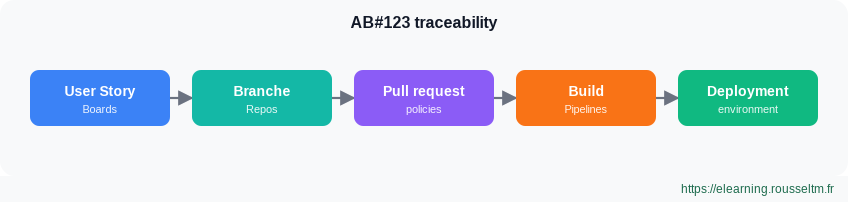
Writing AB#123 in a commit or pull request message automatically links work item 123, and the merge option can move it to done.
Best practice : Protect main with policies from day one: it is easier to start strict than to harden later.Commands to know #
Commands to know
az boards work-item create --type "User Story" --title "…": create a work itemaz repos create --name boutique: create a repositoryaz repos pr create --source-branch taux --target-branch main --work-items 12: open a linked pull requestaz repos policy approver-count create --branch main --minimum-approver-count 1 …: require a reviewer
Sources #
Checked in November 2026: CI/CD platforms change every month, check versions and plans in the vendor's documentation.
My progress
Sign in to track your progress and take notes. Sign in
💬 Questions about this lesson
No questions yet: be the first to ask for help or share your configuration.
Recommended Articles
End-to-end CI/CD (1/5): principles and anatomy of a pipeline
Understand end-to-end CI/CD: continuous integration, continuous delivery and continuous deploymen...
End-to-end CI/CD (3/5): artifacts, registries and environments
Deliver continuously: immutable, versioned artifacts, image and package registries, promoting the...
End-to-end CI/CD (5/5): GitHub Actions, GitLab CI, Jenkins and Argo CD in practice
Compare and use CI/CD tools: GitHub Actions, GitLab CI, Jenkins, Argo CD and Flux; a complete pip...
Microsoft Entra ID, RBAC and Azure Policy: identities, permissions and governance
Manage identities and access on Azure: Microsoft Entra ID (users, groups, MFA, conditional access...
GitLab CI/CD: concepts and architecture
Discover GitLab CI/CD: the DevSecOps platform, the .gitlab-ci.yml file, pipelines, stages and job...
Reusing and securing GitLab pipelines
Industrializing GitLab CI/CD: extends, anchors and !reference, include, CI/CD components and cata...
Collecting with Zabbix: items, preprocessing, discovery and templates
Item types (agent, SNMP, HTTP agent, calculated, dependent), preprocessing (JSONPath, regular exp...
Agent policies, integrations, data streams and pipelines
Build agent policies, add integrations (System, Nginx, Custom Logs), choose namespaces, customise...
GitHub Actions: concepts and how it works
Discover GitHub Actions: events, workflows, jobs, steps and actions, the Marketplace, hosted runn...