1. A complete suite #
Plan, code, build, test, deliver.
The services #
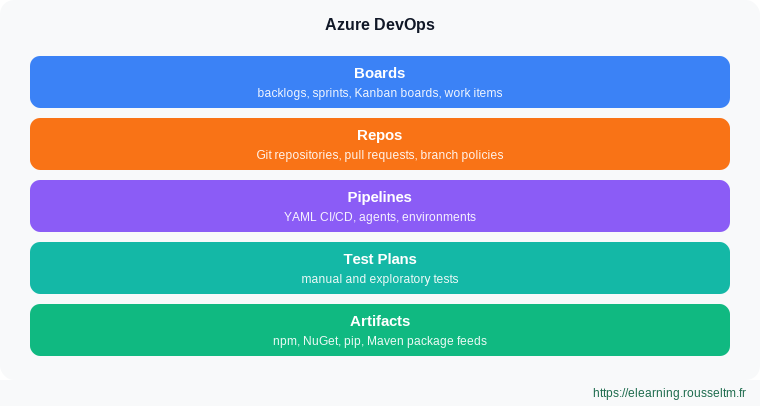
- An organization (
dev.azure.com/my-org) contains projects; each project enables the services it needs. - Azure DevOps Services is the SaaS; Azure DevOps Server is installed on premises (isolated environments, regulatory constraints).
- Services combine with other tools: Pipelines can build a GitHub repository, Boards can track GitHub commits.
2. Plans and alternatives #
What is free.
Free tier #
| Item | Free |
|---|---|
| Basic users | first 5; unlimited Stakeholders |
| Microsoft-hosted agents | 1 parallel job, 1,800 minutes per month, upon a free grant request for new organizations |
| Self-hosted agents | 1 parallel job, unlimited duration |
| Artifacts | 2 GiB of storage |
Good to know : A new organization must request the free hosted parallelism grant (Microsoft form, a few days): meanwhile, a self-hosted agent lets you run pipelines, which is what the labs do.
| Tool | Difference |
|---|---|
| GitHub Actions | action ecosystem, open source community; Microsoft focuses many new features there |
| GitLab CI | single platform with built-in registry and security |
Commands to know #
Commands to know
az extension add --name azure-devops: install the CLI extensionaz devops configure --defaults organization=https://dev.azure.com/<org> project=<projet>: default organization and projectaz devops project list -o table: list projectsaz pipelines list -o table: list pipelines
Sources #
Checked in November 2026: CI/CD platforms change every month, check versions and plans in the vendor's documentation.
My progress
Sign in to track your progress and take notes. Sign in
💬 Questions about this lesson
No questions yet: be the first to ask for help or share your configuration.
Recommended Articles
Azure Boards and Azure Repos: planning and collaborating
Organizing work with Azure Boards (Agile, Scrum, Basic and CMMI processes, work items, backlogs, ...
Azure Pipelines agents: hosted, self-hosted and managed pools
Choosing and running Azure Pipelines agents: Microsoft-hosted agents and images, self-hosted agen...
Azure YAML pipelines: stages, tasks, variables and templates
Writing Azure pipelines in YAML: trigger and pr triggers, stages, jobs and steps, versioned tasks...
Deploying with Azure Pipelines: environments, approvals and service connections
Delivering with Azure Pipelines: multi-stage pipelines, environments, approvals and checks, deplo...
Azure DevOps security, governance and best practices
Running Azure DevOps securely: permissions and groups, protected resources, pipeline authorizatio...
End-to-end CI/CD (3/5): artifacts, registries and environments
Deliver continuously: immutable, versioned artifacts, image and package registries, promoting the...
Writing a .gitlab-ci.yml: jobs, rules, cache and artifacts
Mastering .gitlab-ci.yml syntax: stages, jobs and images, rules and workflow, needs (DAG), cache ...
Organizing DevOps: value streams, teams and a blameless culture
Set up a DevOps organization: value chain and value stream mapping, Team Topologies, « you build ...
Terraform multi-environment, workspaces and repository organization
Organize Terraform for several environments: one folder per environment, tfvars files, CLI worksp...