Enrich your DQL queries and add them to a notebook - Notebooks - Grail
 Watch the video
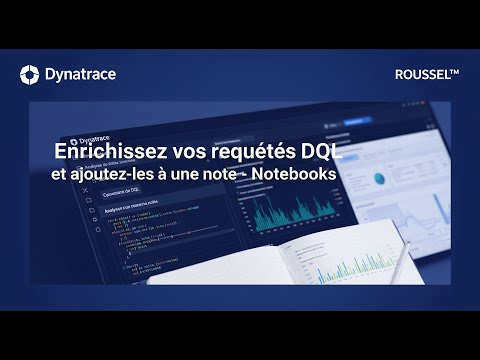
Découvrez comment exploiter la puissance de Grail et de DQL dans les Notebooks Dynatrace ! 🚀 Cette vidéo vous guide à travers l'enrichissement de vos requêtes DQL et leur intégration dans les Notebooks pour une analyse de données approfondie et collaborative. Que vous soyez débutant ou expert, apprenez à tirer le meilleur parti de ces outils ! ✨

🔗 Pour devenir un expert Dynatrace : Visitez notre plateforme de formation sur 👉 https://elearning.rousseltm.fr/

Ne manquez aucune de nos astuces Dynatrace ! Abonnez-vous à notre chaîne et activez la cloche 🔔 pour rester informé et optimiser votre analyse de données !

Ce que vous allez apprendre dans cette vidéo :
Comment enrichir vos requêtes DQL pour des analyses plus poussées. 🔍
Comment utiliser les Notebooks pour organiser et partager vos requêtes DQL. 📝
Les meilleures pratiques pour collaborer avec votre équipe grâce aux Notebooks. 🤝
Des exemples concrets d'utilisation de DQL et des Notebooks dans Dynatrace. 💡
Comment visualiser et interpréter les résultats de vos requêtes DQL dans les Notebooks. 📊
Pourquoi c'est incontournable :
Maîtriser DQL et les Notebooks vous permettra de :

Exploiter pleinement la puissance de Grail pour des analyses approfondies. 💪
Collaborer efficacement avec votre équipe sur des projets d'analyse de données. 🤝
Organiser vos requêtes DQL et vos résultats de manière claire et structurée. 🗂️
Gagner du temps et améliorer votre productivité dans Dynatrace. ⏱️
Prendre des décisions éclairées basées sur des données précises et pertinentes. ✅
Ne manquez pas cette opportunité de devenir un expert de Grail, de DQL et des Notebooks !

#Tags :

#Dynatrace #Grail #DQL #Notebooks #AnalyseDeDonnées #DataAnalysis #Observability #Monitoring #ITOps #DevOps #Tutorial #FormationIT #RousselTM #Collaboration #BigData
Course Glossary
The use of artificial intelligence and machine learning to automate and improve IT operations (e.g., anomaly detection, reducing alert noise).
An open source framework providing standards, APIs, and SDKs to collect and export observability data (traces, metrics, logs) in an agnostic way.
Recommended Articles
Understand the evolution of billing in Dynatrace: the difference between the ...
Discover why and how to configure Grafana Alloy so that it monitors itself, c...
Discover how to enable, secure, and use Grafana Alloy's built-in web interfac...
Discover the fundamental concepts of Grafana Alloy, the transition from the s...
Master Grafana Alloy's declarative syntax (River language), learn to manipula...
Learn how to configure Grafana Alloy to collect, transform, and forward metri...
Discover how to configure Grafana Alloy to read log files, journald, or netwo...
Dive into distributed trace processing. Learn how to ingest OTLP, Jaeger, or ...
Discover how to configure continuous profiling in your environments using Gra...
Learn how to manage large-scale Grafana Alloy deployments. Configure Clusteri...
Discover Grafana Assistant, the artificial intelligence integrated into Grafa...
Comparison between Grafana Alloy and Dynatrace ActiveGate. Understand the fun...