1. The inverted index #
Why search is fast.
Principle #
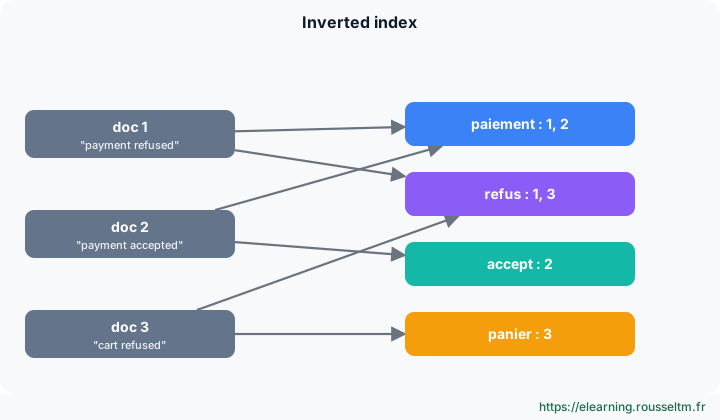
Like a book index, the inverted index maps each term to the list of documents containing it. Searching "refus" means reading one entry, whatever the index size. Everything therefore depends on how text is split into terms: that is the analyzer's job.
Good to know : Requests are written in the OpenSearch Dashboards Dev Tools console format (GET _cluster/health). On the command line, the same request iscurl -sk -u 'admin:Str0ng!Passw0rd-2026' https://localhost:9200/_cluster/health, with-H 'Content-Type: application/json' -d '…'when there is a body.
2. Analyzers #
From text to terms.
Anatomy #
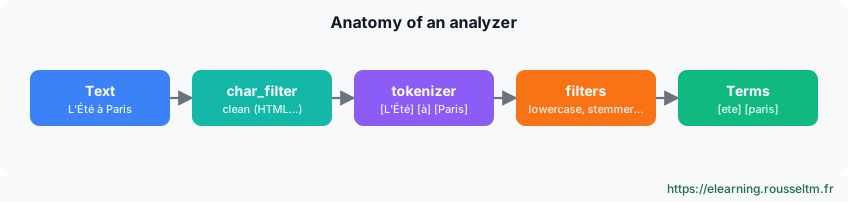
| Step | Role | Examples |
|---|---|---|
| char_filter | change raw text | html_strip, mapping, pattern_replace |
| tokenizer | split into tokens | standard, whitespace, keyword, ngram |
| filter | transform tokens | lowercase, asciifolding, elision, stop, stemmer, synonym |
Testing with _analyze #
POST _analyze
{"analyzer": "standard", "text": "L'Été à Paris"}

POST _analyze
{"analyzer": "french", "text": "L'Été à Paris"}| Analyzer | Resulting terms |
|---|---|
| standard | l'été, à, paris |
| french | ete, pari |
The french analyzer removes elision (l'), stop words (à) and reduces words to their stem: "paiements" and "paiement" yield the same term.
A custom analyzer #
PUT produits-v1
{
  "settings": {
    "analysis": {
      "filter": {
        "fr_elision": {"type": "elision", "articles_case": true, "articles": ["l", "d", "j", "qu", "n", "s", "c", "m", "t"]},
        "fr_stem":    {"type": "stemmer", "language": "light_french"},
        "synonymes":  {"type": "synonym", "synonyms": ["pc, ordinateur", "tv, téléviseur"]}
      },
      "analyzer": {
        "francais_sans_accents": {
          "tokenizer": "standard",
          "filter": ["fr_elision", "lowercase", "asciifolding", "synonymes", "fr_stem"]
        }
      }
    }
  },
  "mappings": {
    "properties": {
      "nom":   {"type": "text", "analyzer": "francais_sans_accents", "fields": {"exact": {"type": "keyword"}}},
      "description": {"type": "text", "analyzer": "francais_sans_accents"},
      "prix":  {"type": "float"},
      "stock": {"type": "integer"}
    }
  }
}
Common mistake : A field's analyzer cannot be changed on an existing index: you must reindex. Test it with _analyze on real examples before creating the index.3. Full-text queries #
Choosing the right query.
Overview #
| Query | Behaviour | Example use |
|---|---|---|
| match | analyzes text, searches terms (OR by default) | search bar |
| match + operator: and | all terms required | narrowing down |
| match_phrase | terms in order, slop for tolerance | "credit card" |
| multi_match | several fields, ^ boosting | name and description |
| fuzziness: AUTO | tolerates typos | "computr" |
| term | exact value, no analysis | keyword field only |
A product search #
GET produits/_search
{
  "query": {
    "bool": {
      "must": [{
        "multi_match": {
          "query": "ordinatuer portable",
          "fields": ["nom^3", "description"],
          "fuzziness": "AUTO"
        }
      }],
      "filter": [
        {"range": {"prix": {"lte": 1200}}},
        {"range": {"stock": {"gt": 0}}}
      ]
    }
  },
  "highlight": {"fields": {"description": {}}},
  "_source": ["nom", "prix"]
}
nom^3 gives the name three times the weight of the description. Price and stock filters do not count in the score and are cached.
Common mistake : Atermquery on atextfield finds nothing: the searched value is not analyzed while the content was. Usematch, or thekeywordsub-field.
4. Relevance #
Understanding and tuning the score.
BM25 #
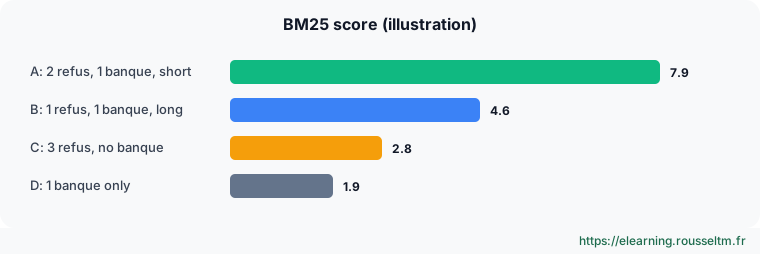
- Term frequency: the more a term appears in the document, the higher the score, with saturation (parameter
k1, 1.2 by default). - Rarity: a term rare in the index weighs more than a frequent one.
- Length: a short field containing the term weighs more than a long text (parameter
b, 0.75).
Explaining and adjusting #
GET produits/_search
{"explain": true, "query": {"match": {"nom": "portable"}}}

GET produits/_search
{
  "query": {
    "function_score": {
      "query": {"match": {"nom": "portable"}},
      "functions": [{"field_value_factor": {"field": "stock", "modifier": "log1p", "factor": 0.5}}],
      "boost_mode": "sum"
    }
  }
}
explain details each document's score computation. function_score adds a business criterion (stock, popularity, freshness) to the text score.
5. Paginating without limits #
from/size, search_after and point in time.
The methods #
| Method | Limit | Use |
|---|---|---|
| from + size | 10,000 results (index.max_result_window) | website pages |
| search_after + PIT | none, frozen view of data | exports, deep pagination |
| scroll | older, costly | to replace with PIT |
POST produits/_search/point_in_time?keep_alive=2m

GET _search
{
  "size": 100,
  "pit": {"id": "<pit_id>", "keep_alive": "2m"},
  "sort": [{"prix": "asc"}, {"_id": "asc"}],
  "search_after": [499.0, "sku-1234"]
}
Commands to know #
Commands to know
POST _analyze: see the terms an analyzer producesGET <index>/_search {"explain": true}: score detailsPOST <index>/_search/point_in_time?keep_alive=2m: freeze a view to paginateGET <index>/_termvectors/<id>: a document's indexed termsPOST <index>/_validate/query?explain: validate and rewrite a query
Sources #
Checked in November 2026 (OpenSearch 3.x, Data Prepper 2.x): OpenSearch ships a minor release about every six weeks, check the release notes before relying on a detail.