1. OpenSearch at a glance #
An open source search and analytics engine.
Overview #
OpenSearch is a distributed search and analytics engine built on Apache Lucene, with its console OpenSearch Dashboards. It serves application search, log analytics, observability, security and, increasingly, vector search. All its components are published under the Apache 2.0 license.
Its history with Elasticsearch #
In 2021, Elastic moved Elasticsearch and Kibana away from the Apache 2.0 license. AWS and contributors then created OpenSearch from the last Apache 2.0 versions (7.10). Since 2024, the project has been hosted by the OpenSearch Software Foundation, within the Linux Foundation. Elastic in turn added an AGPL option to its licenses in 2024.
| Point | OpenSearch | Elasticsearch |
|---|---|---|
| License | Apache 2.0 | Elastic License, SSPL or AGPL, at your choice |
| Security, alerting, ISM | Included plugins | Depends on the subscription |
| Index lifecycle | ISM (_plugins/_ism) | ILM |
| Languages | DSL, SQL, PPL | DSL, SQL, ES|QL |
| Console | OpenSearch Dashboards | Kibana |
The two projects have diverged. Concepts and much of the API remain common, but do not assume that a configuration, client or plugin is compatible: check. Some official Elasticsearch clients refuse to connect to OpenSearch; use the OpenSearch clients.
2. Concepts #
Indexes, shards and replicas.
Vocabulary #
| Concept | Meaning |
|---|---|
| Document | A JSON object |
| Index | A collection of documents |
| Shard | A piece of an index, which is a Lucene index |
| Primary / replica | The original and its copy |
| Mapping | The type of each field |
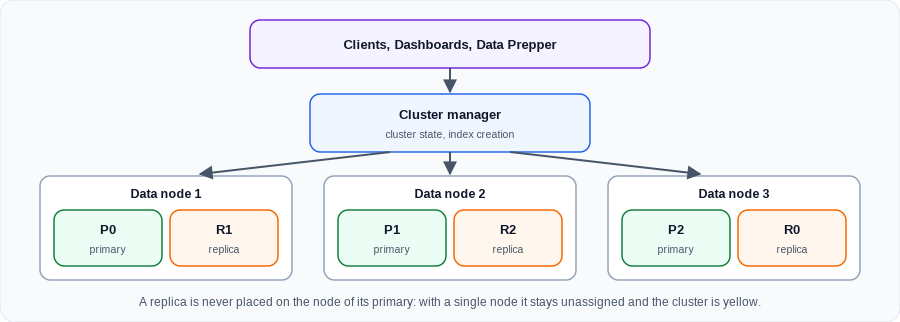
| Cluster manager | Node managing cluster state: the former “master” |
The cluster #
| State | Meaning | What to do? |
|---|---|---|
| green | All shards are assigned | Nothing |
| yellow | Some replicas are unassigned | Normal with a single node; otherwise, add a node |
| red | Some primaries are missing | Urgent: data is unavailable |
3. Components #
What surrounds the engine.
The ecosystem #
| Component | Purpose |
|---|---|
| OpenSearch Dashboards | Exploration, visualizations, administration |
| Data Prepper | Collection and transformation, recommended for ingestion |
| Included plugins | Security, Alerting, Index Management, SQL/PPL, k-NN, Observability, Anomaly Detection… |
The official 3.9 archive ships these plugins and its own JDK; list them with GET _cat/plugins.
4. Migrating from Elasticsearch #
Snapshot, reindex or Migration Assistant.
The paths #

| From | Method | Note |
|---|---|---|
| Elasticsearch 7.0 – 7.10 | snapshot / restore | to OpenSearch 1.x or 2.x, then upgrade to 3.x after reindexing indexes created in 7.x |
| Elasticsearch 7.11+, 8.x | remote reindex | the snapshot format is no longer compatible |
| All, large volumes | Migration Assistant | project tool: data copy, traffic capture and replay, gradual cut-over |
One rule to remember: an OpenSearch major version reads indexes created by the previous major version, no further. OpenSearch 3 reads indexes created in 2.x; an index born in 7.x must be reindexed first.
Remote reindex #
First allow the source host in opensearch.yml (reindex.remote.allowlist: "es-old:9200"), then run:
POST _reindex?wait_for_completion=false
{
  "source": {
    "remote": {"host": "http://es-ancien:9200", "username": "lecteur", "password": "…"},
    "index": "logs-2026.11.*"
  },
  "dest": {"index": "logs-2026.11"}
}
The response gives a task ID, to follow with GET _tasks/<id>. Create the target index template first, otherwise types will be guessed.
Clients and collectors #
| Tool | With OpenSearch |
|---|---|
| Recent Elastic clients | refuse a server that is not Elasticsearch: switch to opensearch-py, opensearch-java, opensearch-js, opensearch-go… clients |
| Beats | only old OSS versions (7.12 at most) work: prefer Fluent Bit, the OTel Collector or Data Prepper |
| Logstash | with the logstash-output-opensearch plugin |
| Kibana | replaced by OpenSearch Dashboards; saved objects can be partly re-imported |
Watch out : Elastic-specific features (ES|QL, ILM, Elastic Agent, Elastic machine learning) have no direct equivalent: list them before migrating and plan for PPL, ISM and OpenSearch plugins.
5. When to choose OpenSearch? #
The criteria for an informed choice.
Criteria #
| Criterion | What to look at |
|---|---|
| Licence | Apache 2.0 without restriction, security and alerting features included |
| Governance | neutral foundation (Linux Foundation), contributors from several companies |
| Ecosystem | managed services, Data Prepper, OpenTelemetry, vector search |
| Existing setup | migration cost of clients, dashboards and rules |
Best practice : Run a proof of concept on your own data: volume, typical queries, key dashboards. That is what decides, not a comparison table.
Commands to know #
Commands to know
GET /: version and distributionGET _cat/plugins?v: installed pluginsPOST _reindex: copy or migrate dataGET _tasks?actions=*reindex&detailed: follow a reindex