1. What is Splunk? #
Index everything, search anything.
Overview #
Splunk, founded in 2003 and acquired by Cisco in 2024, indexes machine data — logs, security events, metrics, API data — and lets you search, correlate and visualize it with SPL (Search Processing Language). Its founding principle: store data as is and extract fields at search time (schema on read).
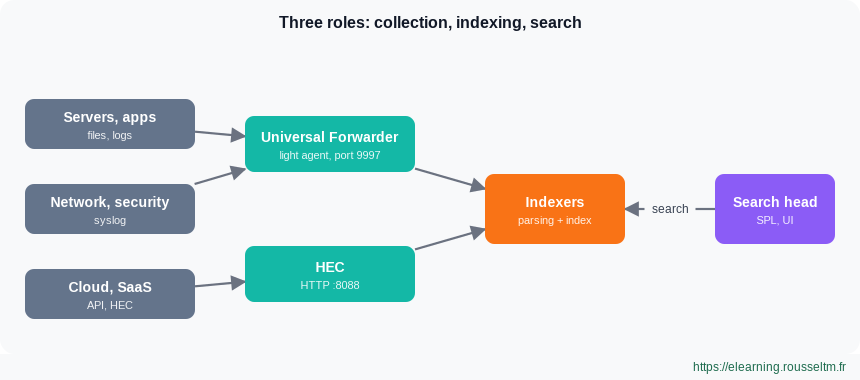
| Component | Role | Port |
|---|---|---|
| Universal Forwarder (UF) | light agent that reads files and logs and sends them without parsing | 9997 (S2S) |
| Heavy Forwarder (HF) | full Splunk that parses, filters and routes before indexing | 9997 |
| Indexer | breaks, timestamps and stores events in indexes | 9997, 8089 |
| Search head | web UI, runs searches on indexers | 8000, 8089 |
| HTTP Event Collector | receives JSON events over HTTP(S) with a token | 8088 |
| Management (splunkd) | REST API, component communication | 8089 |
2. Events and fields #
The data model.
Default fields #
| Field | Content |
|---|---|
| _raw | the original event text |
| _time | the extracted timestamp (or arrival time) |
| host | the originating machine |
| source | the file, port or input |
| sourcetype | the data format: it drives breaking and extractions |
| index | the index where the event is stored (permissions and retention) |
Best practice : Choose onesourcetypeper format (for exampleaccess_combined,pan:traffic) and reuse those of official add-ons: extractions and data models then work effortlessly.
Apps and add-ons #
An app bundles configuration, searches and dashboards; an add-on (TA) provides collection and extractions for a technology (Windows, Linux, Palo Alto, AWS…), normalized to the CIM. More than 2,000 apps are published on Splunkbase.
3. Portfolio and licensing #
Platform, solutions and costs.
The portfolio #
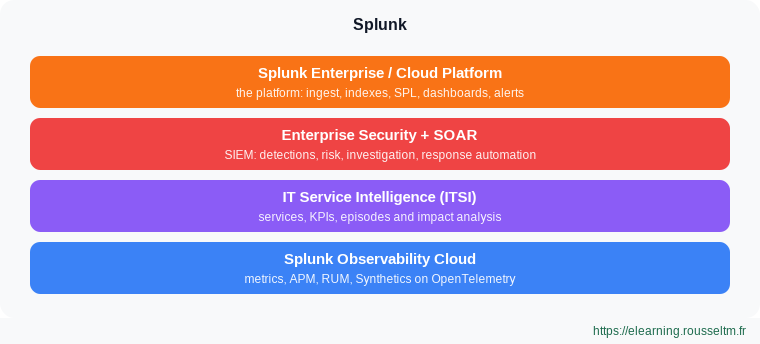
- Splunk Enterprise is installed on your side; Splunk Cloud Platform is the same platform as SaaS, managed by Splunk.
- Solutions install on top: Enterprise Security (SIEM), SOAR (automation), ITSI (service monitoring).
- Splunk Observability Cloud is a separate SaaS product, built on OpenTelemetry (metrics, APM, RUM, Synthetics).
Licensing #
| License | Principle |
|---|---|
| Ingest | volume indexed per day (GB/day), regardless of the number of users |
| Workload | compute capacity consumed (SVC in cloud, vCPU on premises) |
| Enterprise trial | 60 days, 500 MB/day, all features |
| Splunk Free | 500 MB/day, no authentication, no alerts or distributed features |
Watch out : The counted volume is what is written to indexes (excluding internal indexes): filtering or masking before indexing reduces the bill, not after.
Compared with other tools #
| Tool | Difference with Splunk |
|---|---|
| Elastic | schema on write (mapping), Query DSL/ES|QL, partly open source |
| Datadog | observability-oriented SaaS, billed per product |
| Grafana stack (Loki) | indexes only labels, cheap object storage, LogQL |
Commands to know #
Commands to know
$SPLUNK_HOME/bin/splunk start --accept-license: start Splunk$SPLUNK_HOME/bin/splunk status: process statusindex=_internal sourcetype=splunkd log_level=ERROR: Splunk internal errors| tstats count where index=* by index: event volume per index
Sources #
Checked in November 2026 (Splunk Enterprise 10.6): check the release notes before relying on a detail, Splunk Cloud Platform evolves faster than the on-premises version.
My progress
Sign in to track your progress and take notes. Sign in
💬 Questions about this lesson
No questions yet: be the first to ask for help or share your configuration.
Recommended Articles
Administering distributed Splunk
Designing and administering a production Splunk platform: reference architectures, indexer cluste...
SPL: Splunk search fundamentals
Learning the SPL language: search structure, time range and time modifiers, search modes, filteri...
Security and observability with Splunk
Splunk solutions beyond search: Enterprise Security (detections, findings, risk-based alerting, a...
Installing Splunk and ingesting data
Installing Splunk Enterprise (package or Docker), understanding $SPLUNK_HOME and configuration fi...
Advanced SPL and knowledge objects
Going further with Splunk: CSV and KV store lookups, eventstats and streamstats, transaction vers...
Splunk best practices
Best practices for running Splunk in production: data quality and sourcetypes, index design, lice...
Dashboards, reports and alerts in Splunk
Making the most of Splunk searches: reports and scheduling, Dashboard Studio dashboards (data sou...
Cribl: the data pipeline for observability and security
Discover Cribl: why a telemetry data pipeline, the Cribl suite (Stream, Edge, Lake, Search, Cribl...
Sources, destinations and routes in Cribl Stream
Receiving and sending data with Cribl Stream: push, pull, collector and internal sources, event b...