1. Data #
Quality starts at ingest.
Rules #
| Area | Practice |
|---|---|
| Sourcetypes | one per format, the six essential settings set explicitly; reuse add-on sourcetypes |
| Timestamp | check time zone and format: a wrong _time makes data unfindable |
| Index | per permission and retention population; stable naming (org_web_prod) |
| Volume | filter DEBUG and noise before indexing (TRANSFORMS, Ingest actions, Edge Processor); mask personal data |
| CIM | map security sources to the CIM for Enterprise Security |
Best practice : Test each new sourcetype in a staging index with the Add Data wizard before opening it in production.
2. Searches and content #
Frugality and readability.
Rules #
- Always
index,sourcetypeand a time range;statsrather thantransactionorjoin;tstatswhenever possible. - Scheduled rather than real-time alerts; offset windows (
-6mto-1m) to allow for indexing delay; throttling on. - Spread scheduled search times (not all at
*/5on the same minute) and watch skipped searches. - Dashboards: base searches and chains, scheduled reports for shared views.
Watch out : A real-time index=* over all time, run by a user, can slow the whole platform: limit these capabilities per role.3. Platform and security #
Running sustainably.
Regular review #
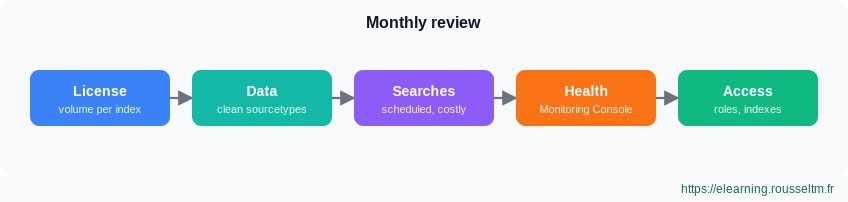
- Configuration in apps versioned in Git, deployed by the deployment server, cluster manager and deployer.
- SAML or LDAP authentication, team roles limited to their indexes, dedicated service accounts for integrations.
- TLS on the UI, port 9997 (S2S) and HEC; HEC tokens per source with allowed indexes.
- Monitoring Console and alerts on blocked queues, silent forwarders and license overage.
Checklist #
| Item | Check |
|---|---|
| Data | clean sourcetypes, correct _time, no personal data in clear |
| License | volume per index tracked, alert at 80% of license |
| Retention | each index retention matches requirements (security, legal) |
| Searches | no continuously skipped scheduled search, no needless real-time alert |
| Availability | suitable RF/SF, rolling restart tested, configuration backup |
| Access | SSO, roles reviewed quarterly, sensitive capabilities reserved |
Commands to know #
Commands to know
splunk btool check: validate configurationindex=_internal source=*license_usage.log type=Usage: license usageindex=_internal sourcetype=scheduler status=skipped: skipped searches| rest /services/data/indexes | table title frozenTimePeriodInSecs maxTotalDataSizeMB: index retention
Sources #
Checked in November 2026 (Splunk Enterprise 10.6): check the release notes before relying on a detail, Splunk Cloud Platform evolves faster than the on-premises version.
My progress
Sign in to track your progress and take notes. Sign in
💬 Questions about this lesson
No questions yet: be the first to ask for help or share your configuration.
Recommended Articles
Installing Splunk and ingesting data
Installing Splunk Enterprise (package or Docker), understanding $SPLUNK_HOME and configuration fi...
Security and observability with Splunk
Splunk solutions beyond search: Enterprise Security (detections, findings, risk-based alerting, a...
Splunk: the machine data platform at a glance
Discover Splunk: the platform's role, components (forwarders, indexers, search heads), ports, eve...
Administering distributed Splunk
Designing and administering a production Splunk platform: reference architectures, indexer cluste...
Dashboards, reports and alerts in Splunk
Making the most of Splunk searches: reports and scheduling, Dashboard Studio dashboards (data sou...
SPL: Splunk search fundamentals
Learning the SPL language: search structure, time range and time modifiers, search modes, filteri...
Advanced SPL and knowledge objects
Going further with Splunk: CSV and KV store lookups, eventstats and streamstats, transaction vers...
The observability trilemma: cost, completeness and performance, and how solutions resolve it
Understanding the observability trilemma (cost, data completeness, query performance), its three ...
Sources, destinations and routes in Cribl Stream
Receiving and sending data with Cribl Stream: push, pull, collector and internal sources, event b...